The Rush
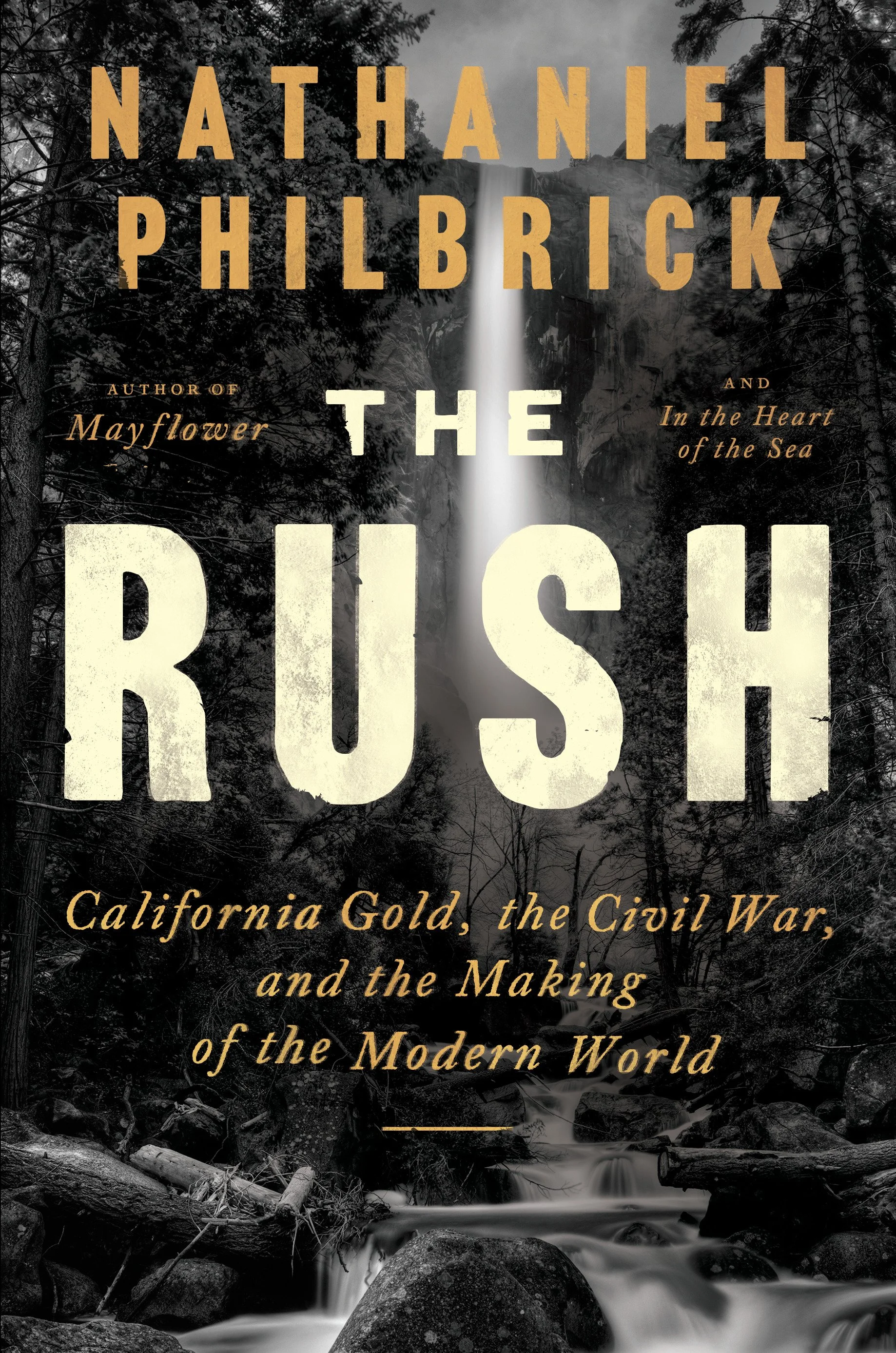
National Book Award winner and Pulitzer Prize finalist Nathaniel Philbrick, author of In the Heart of the Sea and Mayflower, reveals how California’s Gold Rush forged the modern United States—and lit the long fuse to civil war
In January 1848, a carpenter spotted flecks of gold in a shallow stream at Sutter’s Mill in California—triggering the greatest voluntary migration in U.S. history and jolting a fragile republic already sliding toward crisis. In The Rush, Nathaniel Philbrick transforms the Gold Rush from a tale of sudden riches into the origin story of America’s modern contradictions: capital consolidated at dizzying speed, democracy in thrall to private power, xenophobia weaponized in the name of liberty—and a stubborn belief in the American experiment that refuses to die. This is the story of a nation tearing at the seams—a republic tested by its own ideals.
From the feverish gold-mining camps of the Sierra Nevada mountains to the wharves and vigilance committees of San Francisco, Philbrick renders a combustible, all-world society: Chilean brothers reinventing themselves to outrun prejudice; Native communities navigating dispossession and violence; the merchant-showman Samuel Brannan, drawn into the center of early vigilantism; and the politicians vying for control of California’s future—the ambitious free-soil political boss David Broderick, who squared off against William Gwin, the Southern power broker intent on tilting the state toward slavery and the Confederacy. Not until a year after the outbreak of the Civil War, when President Lincoln signed legislation that would unite the nation east to west by building a transcontinental railroad, was California’s loyalty secured.
Philbrick follows the gold as it moves from riverbed to countinghouse to the halls of power, revealing how vigilantism hardened into law and how debates over slavery in the West tipped the balance in Washington. The result is a clear, human story of how a scramble for wealth reshaped ideas of freedom, labor, and belonging—and how California's rise helped push a fractured nation toward war. The Rush is alive with characters whose choices still reverberate: a searing, panoramic epic that captures both the fury and the promise of America.
Nathaniel Philbrick is the author of In the Heart of the Sea, winner of the National Book Award; Mayflower, finalist for the Pulitzer Prize; Valiant Ambition, winner of the George Washington Prize; Bunker Hill, winner of the New England Book Award; Travels with George; Away Off Shore; Second Wind; Sea of Glory; and The Last Stand.
Reviews
“In The Rush, Nathaniel Philbrick takes the old maxim ‘follow the money’ to an engaging and revelatory extreme. Through an intricate skein of little-known stories, he shows how the discovery of gold in California drove tectonic shifts in the way Americans thought about wealth, and about each other—and in the process fueled the Civil War and today’s mad rush toward who knows what.”
—Erik Larson, author of The Demon of Unrest: A Saga of Hubris, Heartbreak, and Heroism at the Dawn of the Civil War
“Like a concentrated beam of light refracted into a brilliant spectrum, Nathaniel Philbrick masterfully illuminates the forces great and small unleashed by the 1848 gold strike at Sutter’s Mill. This richly researched, vividly told narrative captures the rapacious, lawless quest for land and treasure that helped destabilized a fractured Union—and the astonishing human drama that came with it. Philbrick shows how the explosion of the frontier transformed the West, propelled a divided nation toward civil war, and opened a door through which an entire world rushed in. With an extraordinary cast—including a Chilean fortune seeker, an escaped slave, and a Southern sympathizer who rose to become a U.S. Senator from California—he gives voice to the people who were discarded, remade, and occasionally redeemed in one of the most consequential eras in American history.”
—Doris Kearns Goodwin, Pulitzer Prize–winning historian and author of Team of Rivals: The Political Genius of Abraham Lincoln
“Nathaniel Philbrick, our master storyteller, sees in the Gold Rush a Rosetta Stone for pre–Civil War America. It is a confounding and encouraging chronicle told from a myriad of perspectives, a bottom-up, epic tale of an inevitable rush toward profit and near-national suicide.”
—Ken Burns, filmmaker
“Nathaniel Philbrick has long been one of our most elegant narrative historians, and he’s back at it again, writing at the height of his powers. The Rush brings new energy and insight to a massively consequential event we only thought we knew. In a richly pleasing weave, he gives us the micro and macro, the intimate and sweeping, and makes us care about an engaging cast of characters who sought a new life in California’s riches. Along the way, Philbrick considers how the gold rush sped up everything it touched and led directly to the restless, frenetic, hyper-adrenalized culture of today’s America.”
—Hampton Sides, New York Times bestselling author of Blood and Thunder and The Wide Wide Sea
“With characteristic eloquence and insight, Nathaniel Philbrick has given us an illuminating and absorbing account of the California Gold Rush, bringing that tumultuous, thrilling, and complex moment to vivid life. Peopled with memorable figures and paced like a great novel, The Rush is a terrific work of history.”
—Jon Meacham, Pulitzer Prize–winning author of And There Was Light
“With an eye for the perfect detail (sidewalks paved with beef jerky!) and a gift for the panoramic, Nathaniel Philbrick has pinned the Gold Rush, in all its wild color, to the page. Better yet, he follows it across time and across the country, to the slavery debate, the Civil War, and the transcontinental railroad. A sweeping, deeply satisfying narrative, pulsing with frontier energy.”
—Stacy Schiff, Pulitzer Prize–winning author of The Revolutionary: Samuel Adams
“A rush of a narrative that will leave you giddy and full of wonder, turning pages with all the fever of a hopeful prospector. The true gold here is in the pathos beneath the glittering surface: the stories of real people; their brutal contests and conquests; and the breaching and the breaking of the natural terrain. A thrilling and valuable story of the making of America from the maestro of narrative nonfiction.”
—Ilyon Woo, Pulitzer Prize–winning author of Master Slave Husband Wife
“A gripping account of the California dreaming that propelled America forward, for better or worse.”
—Publishers Weekly (starred review)
“[The Rush is] an exploration of the California Gold Rush, linking it with attempts to join the state to the Confederacy. . . . As ever, Philbrick untangles this complex story and makes of it an elegant narrative. . . . A lucid, lively melding of economic and political history that casts new light on the Golden State.”
—Kirkus Reviews
“A panoramic look at the California gold rush, California and the Civil War, and how their events shaped the modern world.”
—Booklist (starred review)
“Sumptuous . . . There’s an echo of Mark Twain in the book’s cadences…Philbrick spins his tale with aplomb, hitting his notes just so, in the mode of David Grann…an engrossing account of tensions at the heart of our republic.”
—Hamilton Cain for the Boston Globe
“With polished prose and impeccable research, historian Philbrick unravels the Golden State’s ties to profit, enslavement and white supremacy. From John Sutter on to a “dress rehearsal” for a Confederate victory and through to resource magnates like Leland Stanford, readers will understand that a conflict between North and South also included the West. They’ll also see that the greed unleashed during 19th century America resource-gathering isn’t gone.”
—Los Angeles Times
“Compulsively readable . . . The Rush complicates the familiar account of hopeful panners and canny outfitters, pairing the romance with the reality and drawing more characters into the story. Philbrick, a seasoned and popular chronicler of the American past, is equally concerned with those who got trampled by the rush as with those who rode it to astonishing heights of wealth and influence. . . . Philbrick brings the era’s gritty political dramas to life with compelling detail and an admirable faith in his readers’ willingness to follow the shifting factions and alliances. . . . Philbrick is a richly talented raconteur and a master of the cinematic vignette.”
—The New York Times Book Review
“The California Gold Rush is the stuff of American legend, but Nathaniel Philbrick’s gripping history shows us just how much gets left out of the familiar story…We were especially drawn to the individual stories he uncovers…Philbrick has a gift for making a huge historical story feel immediate…The Rush made us see the Gold Rush—and the America it helped create—in a whole new way.”
—Apple Books
Interview
Your work as a writer has revisited foundational moments in American history through New England and the Eastern Seaboard. THE RUSH takes you west, to California. What drew you to the Gold Rush, and what made it feel like Philbrick territory?
Ever since I moved to Nantucket Island forty years ago, I have been fascinated by the California Gold Rush. Nantucket was once the whaling capital of the world, and when islanders learned about the discovery of gold, they packed themselves into whaleships and sailed around Cape Horn for California. In nine months, Nantucket lost a quarter of its voting population to the goldfields, and this was happening in towns across the United States and around the world. This was a story I needed to explore, and I soon realized the topic had tentacles that reached further into the history and culture of America than I had ever imagined.
THE RUSH tells the story of an America transformed by speed, technology, and the sudden movement of people, money, and information. What did the Gold Rush reveal about how technological change can reshape a country almost overnight? In 2026, what do you think we could learn from the past as we barrel toward a future shaped by artificial intelligence, social media, and the promise of digital revolution?
The California Gold Rush was as much about technological innovation as it was about gold. In 1849, new inventions like the electric telegraph, steam-powered trains and ships, and photography not only stoked the rush to California but transformed the goldfields and financial world of San Francisco into a rough-and-tumble hothouse of experimentation. Soon innovations like hydraulic mining, in which giant, high-pressure hoses washed away entire mountainsides to get at the gold, were making incredible amounts of money for a few corporations but leaving tens of thousands of miners out of work. By 1860, new gold and silver strikes in nearby Nevada enabled San Francisco financiers, tutored by the previous gold rush, to buy and sell shares of a whole new group of mining companies. Ten years later, the building of the transcontinental railroad created a tiny group of what we would call billionaires today, who soon had a stranglehold on transportation throughout the state. If what happened in California in the nineteenth century is any indication, we are in for a very bumpy ride as society struggles to come to grips with the sudden changes associated with artificial intelligence and all the rest.
One of the remarkable figures in THE RUSH is Mary Ellen Pleasant, an African American woman from Nantucket who became one of San Francisco’s first Black millionaires, even as California’s lawmakers were working to restrict rights of African Americans. How does her story complicate our understanding of the Gold Rush and the American Dream?
We tend to think of the California Gold Rush as its own, self-contained event in which fortune-seeking “Forty Niners” found a new way to achieve what we call the American Dream today. But as the example of Mary Ellen Pleasant proves, it was much more complex than that. Almost as soon as California entered the Union as a free state in 1850, proslavery Southerners began chipping away at the freedoms guaranteed by the state’s constitution. In the meantime, Pleasant helped make California the western terminus of the Underground Railroad and even, according to her own account, used a portion of the money she’d made to finance John Brown’s raid on Harpers Ferry. It was Mary Ellen Pleasant who showed me that the Gold Rush was not just about gold and technology—it was also about the rush to the Civil War.
In many respects, the Gold Rush helped introduce the idea of sudden personal wealth into the American imagination. Why was that such a significant turning point in the country’s history?
Up until the Gold Rush, generations of Americans had led lives that were much like those of their parents. As Mark Twain remembered about his childhood in Hannibal, Missouri, “to get rich was no one’s ambition—it was not in any young person’s thoughts.” Then came the Gold Rush, when Twain was thirteen years old. Suddenly it was possible—if the rumors were to be believed—for just about anyone to get rich in a hurry in California. People became consumed, Twain wrote, with a “lust for money [with all its] hardness and cynicism.” The society in which we live today—all of us locked in a race for instant wealth that only a few can win—was created by the California Gold Rush.
As with each of your books, THE RUSH draws on an immense amount of research, following the story from Nantucket to California to Chile and Mexico. What was your research process like, and what discovery most surprised you?
Once I’d identified the characters I wanted to focus on, I began learning everything I could about them, reading newspaper accounts, journals, diaries, and memoirs while combing archives from Nantucket to California. It was also important to visit the places these people inhabited. Over the last five years, I’ve traced the length of the Oregon-California Trail, panned for gold on the American River where James Marshall found the first nuggets, and visited the field in San Mateo where a proslavery state supreme court justice shot to death a Free Soil U.S. senator. There were surprises almost everywhere I looked, but the biggest, most far-reaching surprise was how tightly connected the Gold Rush was to the series of national events that culminated in the Civil War. Even the building of the transcontinental railroad, with which The Rush ends, was begun in 1862 as a “war measure” to keep California, and all its gold, in the Union. If you had told me five years ago that the Gold Rush and the transcontinental railroad had anything to do with the Civil War, I wouldn’t have believed you. Now I know better.
THE RUSH argues that California was crucial to the fate of the Union, despite being thousands of miles from the major battlefields of the Civil War. How did the gold coming out of California help shape the course of the war?
When the first shots were fired at Fort Sumter, San Francisco was sending between three and four million dollars in precious metals to the East every month. Given the immense amount of debt created by the war, this gold was critical to victory. At one point Ulysses S. Grant wrote, “I do not know what we would do in this great national emergency if it were not for the gold sent from California.” What many Americans don’t appreciate today is how close California, which was dominated politically by proslavery Southerners, came to declaring itself an independent pro-Confederacy republic, which would have been a disaster for the North. Without the eloquent and hugely influential Unitarian minister Thomas Starr King, who traveled from town to town preaching the spiritual sanctity of the Union, it might have turned out very differently.
California remains one of the most powerful political and economic forces in the United States. How did the Gold Rush help create the California we know today?
Gold laid the foundation for what proved to be California’s next economic engine: wheat farming. California’s wheat growers were not traditional farmers. Just as the miners had learned to maximize returns in the goldfields by using water cannons instead of picks, California farmers pioneered monoculture on an industrial scale. Raising cattle and growing fruit were also pursued with the same ruthless drive for profits. In the world created by the Gold Rush, you experimented, failed, and tried again until you finally hit it big, with little concern for the long-term consequences of your actions. This remains the mantra of the most visible heir to the Gold Rush: Silicon Valley, which has been the site of countless technological “gold rushes” throughout the twentieth and twenty-first centuries. If California were its own country today, its economy would be the fourth largest in the world, and it all started with the discovery of gold in 1848.
Questions of who belongs in America—and who has a right to its ideals, opportunities, and resources—run throughout THE RUSH. Miners and other laborers arrived in California from Mexico, Chile, China, and around the world, even as many white Americans claimed the goldfields as their own. How does that conflict speak to the country we live in now?
It took most Americans at least six months, if not longer, to get themselves to California, since they had to either sail around Cape Horn or set out overland from Missouri. By the time they reached the goldfields, they discovered that Native Californians, Mexicans from Sonora, Peruvians, and especially Chileans were already there. In The Rush, I follow the adventures of a Chilean named Vicente Rosales, who writes of the prejudice he and others experienced at the hands of the Americans, who objected to the presence of these early arrivals. Soon state militias were hunting down California’s Native peoples, while a punitive Foreign Miner’s Tax led to rioting in the goldfields by Chileans and the newly arrived French. Today, with renewed efforts to control our country’s borders and the forcible removal of those who have come here illegally, it sometimes seems as if little has changed since the Gold Rush days. We are still trying to figure out just who is an American.
THE RUSH shows the Gold Rush as both a story of extraordinary opportunity and one of violence, exclusion, and dispossession. How do you hold those two truths together as a historian and storyteller?
I write about American history out of a deep love and respect for my country, but I also think you cannot celebrate the nation’s strengths without examining the violence and greed that have been a part of America, and especially California, from the start. Californians conducted what they openly described as a “war of extermination” against the Native peoples. Through the California Land Act, a set of judicial hurdles was created to facilitate the confiscation of the land guaranteed to its original Mexican owners by the treaty that ended the Mexican-American War. And yet, despite these efforts to keep wealth in the hands of California’s white population, the state continues to attract extraordinary numbers of immigrants. California is like the rest of America, but only more so—a place of unprecedented violence, creativity, and opportunity. I’ve tried to tell that story in a way that does justice to both the positive and the negative.
2026 marks the 250th anniversary of the Declaration of Independence, at a moment when many Americans are reflecting on the state of the Union. Do you see meaningful parallels between the upheavals of the 1850s and the divisions of our own time?
After writing three books about the American Revolution and now the California Gold Rush, I’ve come to recognize that this country has always been in a state of crisis. During the twenty-plus years covered in The Rush, there were mass lynchings, bank busts, and riots over land. In 1858, California U.S. senator David Broderick was shot to death in a duel by state supreme court justice David Terry, the victim, the dying Broderick claimed, of a barely concealed political hit. Yes, the times today are fraught, but they were just as bad, if not worse, during the California Gold Rush.
The title THE RUSH suggests something larger than the Gold Rush itself. What does “the rush” come to mean over the course of the book?
The Rush is about the frenetic urge to push ahead as quickly and recklessly as possible in search of the next new thing. It’s a force bigger than any single individual, and whether we admit it or not, all of us are in its grasp as the Rush drags society into an unknowable future at a frightening rate. As I say in the book, it’s as if we are all on an out-of-control train hurtling into the future, and none of us can get off.
California has long occupied a special place in the American imagination: a place of reinvention, wealth, freedom, and escape. How did the Gold Rush create that myth, and what did it conceal?
From the beginning California was a brilliant illusion. The name was invented in the sixteenth century by a Spanish novelist to describe a mountainous island of gold ruled by Queen Califia. It’s almost preternatural how California has become the embodiment of the prophecy contained in its fictitious name. In the years since, countless people—from the “Okies” John Steinbeck writes about in Grapes of Wrath to aspiring actors, musicians, programmers, coders, and immigrants from around the world—have come to California to seek their fortunes. But as the first Forty-Niners discovered, California, the supposed place of instant wealth, will almost always disappoint. “The Time of Miracles is past,” a French miner wrote during the Gold Rush. “The sweetest illusions are lost…. The awakening is all the more terrible as the dreams had been so glittering”—words to which many a failed actor can relate today.
THE RUSH is full of people trying to build order in a place where law, wealth, and violence are all in flux. What does the Gold Rush reveal about the relationship between democracy and private power?
In the beginning, the Gold Rush was a truly democratic phenomenon: anyone who showed up with a pick and pan could make, in theory at least, a fortune. That said, the goldmines were also a place of violence and vigilantism. One of the more fascinating phenomena of the Gold Rush involves the city of San Francisco, where a group of powerful business leaders formed a five-thousand-man army, took over the city, and began to deport and even execute so-called bad characters in the name of justice. Some San Franciscans, including a young banker named William Tecumseh Sherman, came to see the Vigilance Committee of 1856 as a kind of dress rehearsal for the Civil War: an overthrow of existing government in the name of justice that was more about self-interest and suppression of other people’s freedoms.
Your books often return to moments when American ideals collide with ambition, violence, and survival. How does THE RUSH fit into that larger body of work?
Ever since I wrote In the Heart of the Sea, all my books have been, in one way or another, survival tales. Whether it’s 102 Pilgrims on the Mayflower, Armstrong Custer’s Seventh Cavalry at the Little Big Horn, or the city of Boston at the outbreak of the American Revolution, I like to tell the story of communities under enormous stress. Each chapter of The Rush is its own kind of survival tale as I track the progress of the Gold Rush from the discovery of gold through the construction of the transcontinental railroad. For me, some of the most compelling figures are the twenty thousand Chinese workers, almost all of whose names have been lost to history, who built the transcontinental railroad. Talk about a community in crisis: They’d been brought to California under the pretense of earning their fortunes in the goldfields, only to discover that they’d been consigned to the highly dangerous job of building a railroad across the Sierra Nevada Mountains. It’s the kind of story I’ve been attracted to from the beginning: a people thrown into an alien and forbidding world who somehow succeed in building the engineering marvel of the age.
Excerpt
PROLOGUE
California
In 1510, a novelist from Spain invented a place called California.
There was an island, Garci Rodríguez de Montalvo wrote in The
Labors of the Very Brave Knight Esplandián, where the only metal was
gold. “Made up of the wildest cliffs and the sharpest precipices found
anywhere in the world,” this golden island was ruled by Queen Califia
and named California.
The Spanish conquistador Hernán Cortés read Montalvo’s novel with
great interest. He and his men even drew parallels between the riches
they discovered in Mexico and the wonders described by Montalvo and
other romance novelists. By 1535, they had turned their attention to
Mexico’s west coast. At the southern tip of the Baja peninsula, Cortés
and his men began to hear Native accounts of an island dominated by
women of immense wealth. Could this be a real, New World version of
Queen Califia’s domain? In anticipation of the treasures awaiting them
to the north, they named the land California.
In one of the supreme ironies of history, the Spanish became too
preoccupied with plundering precious metals from Mexico, Central
America, and South America to direct their attention to what they came
to call Alta (or Upper) California. Not until 1775 did the first Spanish
ship sail into San Francisco Bay. And yet the fantasy refused to die.
In the summer of 1847— more than three centuries after the region
had been named for an imaginary, jagged-peaked
island of gold— a thirty- seven- year- old carpenter named James Marshall ventured up the
South Fork of the American River into the Sierra Nevada mountains of
California.
James Marshall had grown up in New Jersey, then drifted west to Mis‑
souri, where he’d built a house beside the river and farmed. It wasn’t
long before he came down with “fever and ague”— what we know today
as malaria. A doctor told him that if he didn’t move to a healthier cli‑
mate he would “not live more than two years.” In 1844, Marshall sold
his farm and joined a train of eighty- four wagons headed to Oregon.
There he found work as a carpenter but was disappointed by the con‑
stant rain. So he headed south to California, where he met a Swiss ad‑
venturer named John Sutter, who had enlisted Native laborers to build a
fort along the Sacramento River. Sutter grew wheat and traded in horses,
but what he really needed was lumber. So he contracted with Marshall
to build him a sawmill in the western foothills of the Sierra Nevada
mountains.
In a remote gorge the local Nisenan people called Coloma, Marshall
found a large stand of ponderosa pine. Here, beside a bend in the river,
he would build Sutter’s Mill.
Four months later, the mill was almost finished. Marshall and his men
had laid timbers across a granite base, erected the rough- hewn frame,
and dug the ditch through which water from the river would power the
mill. But as soon as the mill’s waterwheel began to turn, Marshall real‑
ized something was wrong. Instead of turning with forceful regularity,
the wheel kept drowning in its own backwash. It sickened him to admit
it (particularly since he had a financial stake in the venture), but James
Marshall had built the mill too low.
He could have rebuilt the mill. But as one of his workers later re‑
membered, Marshall was “rather a ‘notional’ kind of man.” Even John
Sutter, who “esteemed him highly as a good mechanic,” thought Mar‑
shall “half crazy.” Instead of modifying the mill, Marshall decided to
make the earth conform to what he’d already built. He and his men
would deepen the tailrace— the ditch that carried the water back to the
river— even if it meant digging through a nearly solid layer of rock.
During the day, they used picks, crowbars, and even gunpowder to
remove the granite boulders at the bottom of the tailrace. But it was at
night, when they lay asleep beneath the glittering stars, that the real work
began. Every night Marshall raised the headgate and let the pebble-
clattering waters of the river scour out the tailrace.
When Marshall awoke on the morning of Monday, January 24, he
was eager to see what the river had revealed. Since no work had been
conducted on the Sabbath, water had been rushing through the tailrace
for almost two days. First, he closed the headgate, pounding it down with
a sledge and throwing in some dead leaves and sawdust to seal the gate
“extra tight.” Once the water flowing under the mill had shrunk to a
trickle, he climbed down into the tailrace’s gravelly depths. He was ex‑
amining the broken granite at his feet when he noticed something un‑
usual. He stooped down to take a closer look.
About half an hour later, Marshall crawled out of the tailrace, cradling
his hat to his chest like a hurt child. His men, still busy finishing the
mill, ignored him.
“I have found it,” Marshall announced.
One of the men looked up from his workbench and asked, “What
is it?”
“Gold,” Marshall said.
“Oh, no,” the man shot back, “that can’t be.”
“I know it to be nothing else,” Marshall insisted.
Soon the men had left their tools and were gathered around Mar‑
shall, who stood before them with his hat in his hands. Collected in its
knocked‑ in crown was about “a teaspoon” of yellow fragments, “most of
it . . . in very thin small flakes.” As subsequent events would soon con‑
firm, James Marshall had discovered gold in the tailrace of Sutter’s Mill.
California is an ocean- laved polygon of stupendous geographical vari‑
ety. Down its middle runs the Great Central Valley: a narrow, dead- level
plain divided lengthwise by the south- flowing Sacramento and the
north- flowing San Joaquin rivers. Like the Tigris and Euphrates in the
Middle East, these two waterways meet at a common delta: a floodplain
of more than a thousand square miles that feeds into what eventually
becomes San Francisco Bay, one of the largest natural harbors in the
world.
All these features are notable, but it is the mountains— the rain-
softened peaks of the Coastal Range and the snow- crowned immensity
of the Sierra Nevadas to the east— that dominate California, evoking in
their rugged grandeur the geologic maelstrom that produced one of the
richest gold deposits ever known.
They called it the Mother Lode: a snakelike vein of quartz- encapsulated
gold that extended for more than 150 miles along the western edge of the
Sierra Nevada mountains. Created between 100 and 120 million years
ago, as the North American continent collided with the massive bits of
tectonic flotsam that would become California, the golden striations
of the Mother Lode were precipitated from a subterranean mash‑ up of
mineral- rich ocean floor, magma, and superheated water.
Countless cultures throughout the centuries have valued gold above
all else. Christopher Columbus went so far as to claim that he “who has
gold has a treasure [that] even helps souls to paradise.” Gold is so mal‑
leably soft and lustrous it’s easy to forget it is a metal five times more
dense than lead. Chemically inert, gold does not tarnish, and there is
almost nothing that will dissolve it. Whether it’s been beaten to the
thinness of an eggshell or poured into a mold to create an ingot, gold is
eternally brand new. Most of all, however, gold is rare. If all the gold
ever found in the world was assembled in one place, it would fill just
three and a half Olympic- size swimming pools.
In most parts of the planet, gold is found in concentrations of five
parts per billion. In the Mother Lode of California, gold was found in
concentrations of one hundred million parts per billion. Over the eons,
cataracts of river water had washed over the Mother Lode, scattering
eroded bits of gold like buckshot across the foothills. Known as placers
(pronounced “plassers”), these pieces of gold ranged in size from the tiny
flakes first collected by James Marshall to the 195- pound “nugget” found
on Carson Hill in 1854, and they were there for the taking. Over the course
of a mere decade, a whopping 848 tons of gold would be extracted from
California— almost five times the amount Spain had obtained from the
Americas in a century and a half.
It had taken more than three hundred years, but the prophecy con‑
tained within the name of California had finally come true.
Two years before the discovery of gold at Sutter’s Mill, the United States
went to war with Mexico— a conflict freshman congressman Abraham
Lincoln condemned as “unnecessarily and unconstitutionally com‑
menced” by President James Polk. Although fighting ended with the
capture of Mexico City in October 1847, the war did not officially con‑
clude until February 2, 1848— nine days after Marshall’s discovery— with
the signing of the Treaty of Guadalupe Hidalgo. In that pact, Mexico
ceded more than half its country to the United States: the future states
of Utah, New Mexico, Arizona, Nevada, and California, along with parts
of Colorado, Wyoming, Kansas, and Oklahoma. Together with the recent
addition of Texas and the Oregon Territory, America had essentially dou‑
bled in size in just two years. That in itself was astonishing— but then
to learn within a year of the war’s conclusion that the most distant part
of this newly bicoastal nation contained immense quantities of gold was
even more difficult to believe.
President Polk made the discovery official in his annual message to
Congress on December 5, 1848. By then, gold fever had been raging in
California for months. James Carson had been a soldier stationed in
Monterey when he first heard that gold had been discovered in the foot‑
hills of the Sierras. “A frenzy seized my soul,” he remembered. “Unbid‑
den, my legs performed some entirely new movements of polka steps—I
took several. Houses were too small for me to stay in; I was soon in the
street in search of necessary outfits. Piles of gold rose up before me at
every step; castles of marble, dazzling the eye with their rich appliances . . .
were among the fancies of my fevered imagination. . . . In short, I had a
very violent attack of gold fever.”
Soon gold fever had spread across the United States. But there was a
problem. With 1.2 million square miles of recently acquired territory
between them and the gold, how were the American people supposed to
get to California? Over the last decade there had been remarkable ad‑
vances in transportation. Seven thousand miles of railroads now criss‑
crossed the eastern portion of the nation, while steamships sped up and
down just about any body of water that could float a boat. The advent of
the electric telegraph had made communication almost instantaneous.
Thanks to these innovations, word of the discovery spread with un‑
precedented speed— not only across the United States, but around the
world.
Unfortunately, these same technological advances were of less help
in transporting the average American citizen to the west coast of his or
her country. The railroad had only made it as far west as Chicago, and a
steamship’s side- mounted paddlewheels were too fragile to survive the
seas off the storm- wracked tip of Patagonia at Cape Horn. If you had
the money, a steamer could get you to the Atlantic side of the Isthmus of
Panama, but finding transportation on the Pacific side was proving dif‑
ficult in the winter of 1849. That left the two traditional but painfully
slow routes to California: either around the Horn in a sailing vessel or
across the western interior behind a team of oxen, each of which could
take five to six months.
Instead of the culmination of America’s much- ballyhooed Manifest
Destiny, the country’s new continental proportions had suddenly be‑
come an obstacle to be surmounted in the mad dash for gold. A seeth‑
ing impatience gripped the American people that hasn’t let go of us yet.
In 1849, Nathaniel Currier published a humorous print titled The
Way They Go to California. In this lithograph, an angry group of what
would soon be called forty- niners crowd the New York City waterfront
and even leap into the harbor as a fleet of ships bound for the goldfields
sails off without them. Antic figures in flying machines fill the sky above:
a man clings to a rocket, his hat blown off behind him; another falls
from the clouds in a parachute as a cigar- shaped dirigible joins the des‑
perate, patently ridiculous rush to California. This is the world in which
we live today, jammed into jets on our frantic way to the next new thing—
a world created in 1849 by the California Gold Rush.
Despite the fanciful forms of aerial transportation depicted in the
lithograph, the way to get somewhere fast at the midpoint of the nine‑
teenth century was by rail. Even before the discovery of gold, there had
been proposals before Congress to build a railroad to the Pacific. By 1849,
when more than forty thousand gold seekers headed overland to Cali‑
fornia, the call to connect America’s two coasts by railroad had become
even more strident. But efforts to build a transcontinental railroad in
the decade ahead were repeatedly scuttled by the divisions created by
slavery— divisions exacerbated by California’s gold- fueled dash to state‑
hood in 1850. Not until the nation had been plunged into devastating
internecine war did Congress finally pass the legislation required to build
a railroad to California, launching a race between East and West to unite
what had been torn apart by slavery with a railroad that stretched from
sea to sea.
Ever since I moved to Nantucket Island almost forty years ago, I have
been fascinated by the California Gold Rush. Over the course of nine
months in 1849, Nantucket, once the whaling capital of the world, lost
a quarter of its voting population to the goldfields. By the end of the
year, six hundred islanders— including thirty- five Coffins, twenty- eight
Folgers, and twenty- five Swains— had packed themselves into whale‑
ships and sailed to California. Once anchored within the Golden Gate,
the Nantucketers abandoned the vessels upon which they had once de‑
pended for their livelihoods and lit out for the goldfields. This was a
story I needed to explore.
I had just started my research when I came across an African Amer‑
ican woman named Mary Ellen Pleasant. In her youth, Pleasant worked
for a Quaker shopkeeper on Nantucket before joining the western exo‑
dus to California, where she became the nineteenth- century equivalent
of a multimillionaire.
Even as her many business ventures flourished in San Francisco,
proslavery Southerners in California’s legislature and judiciary sought
to roll back the freedoms promised to African Americans in the state’s
constitution. Alarmed by developments not only in California but across
the nation, Pleasant traveled east in 1858 to provide substantial finan‑
cial support for what would become John Brown’s raid on Harpers Ferry.
I began to realize that the discovery of gold in California was part of a
much larger— and ultimately more consequential— rush: the rush to the
Civil War.
This is the story of how the discovery of gold at Sutter’s Mill sent the
nation hurtling toward a reckoning not only with slavery but with its
geographic immensity. At the center of the narrative is the clash be-
tween California’s two U.S. senators: the handsome confidence man
from Mississippi who set out to align the free state of California with
the South and the brash political boss from New York whose death in a
duel threatened to fulfill Southern designs on California’s gold.
But there are a host of other characters: the Nisenan boy who made
the mistake of taking a miner’s sack of gold; the nineteen- year- old vet‑
eran of the Mexican- American War who angrily opposed a Texan’s at‑
tempt to establish slavery in the gold mines; the fugitive slave from
Maryland who decided to flee to California instead of Canada; the
Cherokee slaveholder who turned the life and death of a Mexican ban‑
dit into a timeless tale of heroism and tragedy; the Ohio- born banker
who opposed the army of vigilantes that took over San Francisco in the
summer of 1856; the Unitarian minister who traveled the state preach‑
ing the spiritual sanctity of the Union; and last, the four shopkeepers
from Sacramento and the twenty thousand laborers from China who
built the bridge of iron rails that connected the golden island of Califor‑
nia to the financial centers of the Northeast. At once intimate and pan‑
oramic, this is, in the end, the story of how a diverse and often violent
community on the western edge of the continent wrestled with a ques‑
tion that Americans are still asking today: Just who are we?
But first, let us return to the lithograph by Nathaniel Currier and
the hullabaloo on the New York City waterfront. Look at those wild- eyed
forty- niners clamoring for a ship to California, driven to near lunacy by
the knowledge that tens of thousands of people are already there—
many
of them Hispanic and Native Californians taking gold that is, in the
Americans’ minds, rightfully theirs. And it is only getting worse as thou‑
sands of Mexicans from Sonora, many of them experienced miners, pour
across the border into California. Farther to the south, Peruvians and
especially Chileans are piling into ships and sailing up the coast. And
then there are the Australians and Chinese, who are less than half as far
from San Francisco as an American boarding a sailing vessel in New York
that must travel at least thirteen thousand miles around Cape Horn be‑
fore it reaches California.
“The rush from all quarters is astonishing,” a seagoing New Yorker
reports from Callao, Peru. Rumor has it, he writes, that a coalition of
Mexicans and South Americans have seized control of the goldfields
and are “driving our people before them.” Once the New Yorker’s ship
is back at sea and headed to San Francisco, he and the other passengers
begin conducting military drills in anticipation of the impending strug‑
gle to win back California from the foreigners. “Wait until our fleet of
California boys now in the Pacific get there,” he boasts, “and you will
hear of fun.”
A wild, ungovernable energy has been unleashed by the discovery of
gold, and no one knows where it is headed. By the middle of 1849, more
than fifty thousand people from all six continents of the world are rac‑
ing to California. On December 20, 1848, just as this great global rush
is getting underway, a forty- one- year- old Chilean named Vicente Pérez
Rosales and his three brothers depart from Valparaíso for San Fran‑
cisco.